label_stop_radio

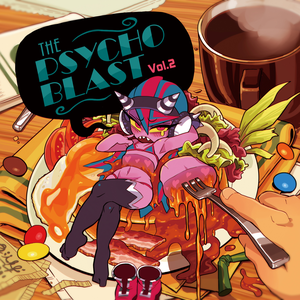
THE PSYCHO BLAST Vol.2
RedOgre (born Ryuta Ishido, August 2) is a Japanese producer and DJ whose career is centered on some of the most extreme forms of hardcore and speedcore. Active since the mid-2000s, he developed a distinctive sound built around extraordinarily fast tempos, distorted kicks, abrasive synthesizers, and an unusually physical approach to live performance. Over the course of his career he has become an established figure in Japan's underground speedcore and terrorcore scenes, releasing music through labels including Maddest Chick'ndom Records, Psycho Filth Records, FREAKIN WORKS, Sketchup! Recordings, and others. Although his music can initially sound almost impossibly aggressive, RedOgre's artistic philosophy is surprisingly straightforward: extreme music is still dance music. His goal has consistently been to make music that is extraordinarily fast while retaining a rhythmic and physical relationship with the dance floor. RedOgre has discussed his musical beginnings extensively in a 2017 interview with the Japanese music publication GHz. While attending university, he became involved in extracurricular activities involving PA and sound engineering. His work included handling sound for bands, assisting with wind-ensemble concerts, and helping construct and operate the sound system for his university's cultural festival main stage. Thus, his first serious relationship with music was initially technological and practical rather than that of a conventional musician. He already wanted to produce club music himself, but initially struggled to take the first step. He recalled being unfamiliar with computers and feeling that digital music production was more difficult to approach at the time. While continuing his PA activities, however, he eventually began experimenting with music under the name RedOgre. His earliest activities were primarily as a speedcore DJ. Soon after beginning to DJ, he became a resident at a party where organizers planned to distribute a free compilation CD. RedOgre contributed a track to that compilation, effectively making it his first production. The first track he made was 220 BPM Frenchcore, followed by another hardcore track around 280 BPM. Even at this extremely early stage, therefore, the attraction to extraordinarily high tempos was already central to his musical identity. The name RedOgre has an unusually specific origin. According to RedOgre himself, the starting point was an artist called BigFoot, whom he encountered around 2004 through a Japanese mobile-phone ringtone/music service called Mobile Music G6. The service specialized in original club music designed to take advantage of the sound capabilities of Japanese mobile phones. BigFoot was one of the service's six music creators and specialized in EBM-influenced music characterized by particularly thick, powerful sound design. RedOgre regarded him as an important inspiration. When deciding on his own artist name, he immediately thought of BigFoot. His reasoning was essentially: BigFoot → a powerful monster → Japanese monster → oni → red oni → RedOgre. Because he particularly liked the color red and was interested in Japanese culture and imagery, he settled on the idea of a red oni, translating it into English as RedOgre. He deliberately retained the unusual capitalization of RedOgre, with both the R and O capitalized, and no space between the words, as a stylistic reference to BigFoot's name. The name therefore isn't simply an arbitrary evil stage name. It reflects a combination of an early musical influence, his interest in Japanese monster imagery, and his personal preference for red. The decisive moment in RedOgre's musical development came in 2006, when he saw a live performance by the Kansai-based Japanese hardcore artist WARST. What particularly shocked him was hearing music at approximately 300 BPM through a powerful sound system. For RedOgre, the experience was transformative. He was struck by the sheer momentum of music moving at such an extreme speed and realized that this was the sound he wanted to create himself. He has subsequently described WARST as the artist he respects most and identified that 2006 experience as the fundamental root of his own style. This helps explain something important about RedOgre's music: the speed isn't merely a technical gimmick. The sensation of extreme velocity is itself one of the central artistic subjects of his work. As RedOgre's production developed, he became increasingly involved in Japan's underground hardcore-techno network. He released original tracks and remixes through numerous Japanese and international labels, including Sketchup! Recordings, Psycho Filth Records, FREAKIN WORKS, and Maddest Chick'ndom Records. He also contributed a remix to a 20th-anniversary album for Rotterdam Terror Corps, connecting his work to the broader international Terrorcore tradition. His live activity was equally important. By the early 2010s he was performing regularly at Japanese parties, increasingly appearing outside the narrow hardcore-techno circuit as well. A 2012 listing from Tokyo's MOGRA described him as a Tokyo-based producer and DJ whose performances had evolved from conventional hardcore DJ mixing into something considerably more unusual. He would deconstruct and reconstruct his own Gabber and Speedcore material, sometimes using CDJ sampling, creating performances that could not necessarily be reproduced identically twice. This emphasis on performance became one of the defining characteristics of RedOgre's career. RedOgre's live performances are perhaps almost as distinctive as his productions. The origin of his unusual performance style was almost accidental. At one party, he was booked for only ten minutes. He began thinking about how he could make ten minutes as impactful as possible. His solution was unconventional: rather than standing inside the DJ booth, he would stand in front of it, facing away from the audience while mixing. He originally intended this to be a one-off experiment. Instead, he found that being physically closer to the dance floor was more exciting, and he continued using the approach at subsequent performances. His sets are also designed around contrast. Because Terrorcore and Speedcore are so relentlessly fast, RedOgre believes that a completely uniform set can exhaust listeners. He therefore pays particular attention to variation and pacing within a set. The intensity of his performances has occasionally been genuinely physical. He recalled one particularly memorable performance during which he became so energetic that he ended up bleeding. This physicality is significant to understanding RedOgre. His music isn't conceived merely as something to listen to through headphones. It is music designed to be experienced through large speakers, bodies, movement, and a crowded club environment. RedOgre's core genres are Terrorcore and Speedcore, although his work has never been completely confined to those categories. His 2017 album Jet Riddim For the Hardest incorporated elements of Breakcore, Frenchcore, and Hard Techno alongside his primary Terrorcore style. Understanding his own production process is particularly revealing. He generally begins with the kick, first choosing a BPM and key and then repeatedly processing a single sound until he obtains the desired tone. He exports material as audio and subsequently manipulates the resulting files inside his DAW. He then builds the rhythmic structure, adds synthesizers, exports and reimports those sounds, slices and edits them, and finally mixes the individual sections. He described the process as essentially kneading audio files. At the time of his 2017 interview, his principal setup consisted of ACID Pro 7, various freeware/shareware plug-ins, a Roland UA-25 EX audio interface, Roland RH-300 headphones, and Yamaha MSP5 Studio monitors. He described the setup as deliberately simple. Interestingly, despite working across a broad BPM range, he identified approximately 250 and 300 BPM as particularly satisfying tempos, along with their half-time equivalents around 125 and 150 BPM. The philosophy behind RedOgre's music becomes particularly clear when he discusses Jet Riddim For the Hardest. The album's central concept was fast and danceable dance music. RedOgre explicitly rejects the idea that extreme-speed music stops being club music simply because its BPM becomes excessive. For him, even extremely fast Speedcore remains fundamentally a form of dance music. He therefore approaches production with the dance floor in mind. This creates an interesting contradiction: his tracks can be so fast and violent that conventional dancing becomes almost impossible, yet their underlying construction remains intensely rhythmic and club-oriented. RedOgre himself joked that he often makes tracks that are not actually very danceable despite this philosophy. This tension between danceability and extremity is arguably the central aesthetic principle of his work. When asked which of his own tracks he felt most strongly attached to, RedOgre identified SPARK OUT FREAKIN TERROR. The track appeared on the first compilation released by FREAKIN WORKS, a label focused on high-tempo hardcore music. RedOgre said he deliberately made it while thinking about the label's sound and incorporated a break-related gimmick that he had been carrying around as an idea for some time. The track eventually became strongly associated with his identity: listeners would tell him that it was the track that immediately came to mind when they thought of RedOgre. It was later remixed by Kobaryo, who transformed it into an upbeat interpretation. RedOgre has also worked under another name: Bound Round. The reason for creating the alias was artistic rather than mysterious. Techno was actually one of the first forms of club music he encountered, and he had originally intended to become a techno artist even before beginning his DJ and production career. Initially, he simply incorporated techno into RedOgre's activities. Eventually, however, he felt that the musical philosophies were sufficiently different to justify separating them. His own characterization was essentially that RedOgre represents aggressive, forward-charging hardcore, whereas Bound Round represents quieter, minimalist techno. The same person is behind both projects, but the aliases allow the listener to understand immediately what kind of music to expect. This distinction also reveals that RedOgre is not simply interested in maximalism. He has an appreciation for minimal, restrained electronic music as well; he simply considers it sufficiently different from his hardcore work to require a separate artistic identity. Although RedOgre is primarily associated with electronic hardcore, his musical world is broader. Because of his background in PA and his participation in underground events, he frequently encountered extreme live bands, including metal and grindcore acts. He said that performing alongside these groups allowed him to experience their physical energy directly and subsequently incorporate some of that feeling into his electronic productions. He particularly valued the different kind of rhythmic energy found in live band music compared with programmed club music. This helps explain why RedOgre's music can sometimes feel more aggressive and physical than conventional electronic dance music: his aesthetic is informed not only by rave culture but also by the bodily intensity of extreme live music. RedOgre occupies an interesting position in Japanese electronic music. He is not a mainstream electronic artist, nor is he primarily associated with the more commercially visible Japanese hardcore world. Instead, his career has developed inside the much smaller and more extreme Terrorcore/Speedcore underground. Yet within that environment he has achieved considerable longevity. From his beginnings as a university PA technician and Breakcore/Speedcore DJ, through his first recordings, his 2014 Masterpiece Grenade, his 2017 Jet Riddim For the Hardest, his Bound Round techno project, and his continuing releases in the 2020s, RedOgre has maintained essentially the same fundamental artistic obsession: how far can electronic dance music push speed, impact and physical intensity without ceasing to be dance music? Perhaps the most revealing statement RedOgre has made about his career is also the least complicated. After approximately ten years of making music, he was asked what he had gained from the experience. His answer was essentially: Playing at clubs is fun. He explained that after years of producing tracks, performing live, drinking, attending parties and participating in the scene, what remained most important was the experience of hearing loud dance music through a powerful sound system and enjoying an unusual, almost non-everyday atmosphere with music and other people. That sentiment provides a useful key to understanding RedOgre's entire career. The violence of the sound is not necessarily the point in itself. The 250-300+ BPM kicks, distorted synths, frantic edits and chaotic performances are ultimately tools for creating a particular physical and communal experience. RedOgre's music is therefore best understood not simply as very fast electronic music, but as an attempt to transform speed itself into a form of club energy. Read more on Last.fm. User-contributed text is available under the Creative Commons By-SA License; additional terms may apply.
RedOgre (born Ryuta Ishido, August 2) is a Japanese producer and DJ whose career is centered on some of the most extreme forms of hardcore and speedcore. Active since the mid-2000s, he developed a distinctive sound built around extraordinarily fast tempos, distorted kicks, abrasive synthesizers, and an unusually physical approach to live performance. Over the course of his career he has become an established figure in Japan's underground speedcore and terrorcore scenes, releasing music through labels including Maddest Chick'ndom Records, Psycho Filth Records, FREAKIN WORKS, Sketchup! Recordings, and others. Although his music can initially sound almost impossibly aggressive, RedOgre's artistic philosophy is surprisingly straightforward: extreme music is still dance music. His goal has consistently been to make music that is extraordinarily fast while retaining a rhythmic and physical relationship with the dance floor. RedOgre has discussed his musical beginnings extensively in a 2017 interview with the Japanese music publication GHz. While attending university, he became involved in extracurricular activities involving PA and sound engineering. His work included handling sound for bands, assisting with wind-ensemble concerts, and helping construct and operate the sound system for his university's cultural festival main stage. Thus, his first serious relationship with music was initially technological and practical rather than that of a conventional musician. He already wanted to produce club music himself, but initially struggled to take the first step. He recalled being unfamiliar with computers and feeling that digital music production was more difficult to approach at the time. While continuing his PA activities, however, he eventually began experimenting with music under the name RedOgre. His earliest activities were primarily as a speedcore DJ. Soon after beginning to DJ, he became a resident at a party where organizers planned to distribute a free compilation CD. RedOgre contributed a track to that compilation, effectively making it his first production. The first track he made was 220 BPM Frenchcore, followed by another hardcore track around 280 BPM. Even at this extremely early stage, therefore, the attraction to extraordinarily high tempos was already central to his musical identity. The name RedOgre has an unusually specific origin. According to RedOgre himself, the starting point was an artist called BigFoot, whom he encountered around 2004 through a Japanese mobile-phone ringtone/music service called Mobile Music G6. The service specialized in original club music designed to take advantage of the sound capabilities of Japanese mobile phones. BigFoot was one of the service's six music creators and specialized in EBM-influenced music characterized by particularly thick, powerful sound design. RedOgre regarded him as an important inspiration. When deciding on his own artist name, he immediately thought of BigFoot. His reasoning was essentially: BigFoot → a powerful monster → Japanese monster → oni → red oni → RedOgre. Because he particularly liked the color red and was interested in Japanese culture and imagery, he settled on the idea of a red oni, translating it into English as RedOgre. He deliberately retained the unusual capitalization of RedOgre, with both the R and O capitalized, and no space between the words, as a stylistic reference to BigFoot's name. The name therefore isn't simply an arbitrary evil stage name. It reflects a combination of an early musical influence, his interest in Japanese monster imagery, and his personal preference for red. The decisive moment in RedOgre's musical development came in 2006, when he saw a live performance by the Kansai-based Japanese hardcore artist WARST. What particularly shocked him was hearing music at approximately 300 BPM through a powerful sound system. For RedOgre, the experience was transformative. He was struck by the sheer momentum of music moving at such an extreme speed and realized that this was the sound he wanted to create himself. He has subsequently described WARST as the artist he respects most and identified that 2006 experience as the fundamental root of his own style. This helps explain something important about RedOgre's music: the speed isn't merely a technical gimmick. The sensation of extreme velocity is itself one of the central artistic subjects of his work. As RedOgre's production developed, he became increasingly involved in Japan's underground hardcore-techno network. He released original tracks and remixes through numerous Japanese and international labels, including Sketchup! Recordings, Psycho Filth Records, FREAKIN WORKS, and Maddest Chick'ndom Records. He also contributed a remix to a 20th-anniversary album for Rotterdam Terror Corps, connecting his work to the broader international Terrorcore tradition. His live activity was equally important. By the early 2010s he was performing regularly at Japanese parties, increasingly appearing outside the narrow hardcore-techno circuit as well. A 2012 listing from Tokyo's MOGRA described him as a Tokyo-based producer and DJ whose performances had evolved from conventional hardcore DJ mixing into something considerably more unusual. He would deconstruct and reconstruct his own Gabber and Speedcore material, sometimes using CDJ sampling, creating performances that could not necessarily be reproduced identically twice. This emphasis on performance became one of the defining characteristics of RedOgre's career. RedOgre's live performances are perhaps almost as distinctive as his productions. The origin of his unusual performance style was almost accidental. At one party, he was booked for only ten minutes. He began thinking about how he could make ten minutes as impactful as possible. His solution was unconventional: rather than standing inside the DJ booth, he would stand in front of it, facing away from the audience while mixing. He originally intended this to be a one-off experiment. Instead, he found that being physically closer to the dance floor was more exciting, and he continued using the approach at subsequent performances. His sets are also designed around contrast. Because Terrorcore and Speedcore are so relentlessly fast, RedOgre believes that a completely uniform set can exhaust listeners. He therefore pays particular attention to variation and pacing within a set. The intensity of his performances has occasionally been genuinely physical. He recalled one particularly memorable performance during which he became so energetic that he ended up bleeding. This physicality is significant to understanding RedOgre. His music isn't conceived merely as something to listen to through headphones. It is music designed to be experienced through large speakers, bodies, movement, and a crowded club environment. RedOgre's core genres are Terrorcore and Speedcore, although his work has never been completely confined to those categories. His 2017 album Jet Riddim For the Hardest incorporated elements of Breakcore, Frenchcore, and Hard Techno alongside his primary Terrorcore style. Understanding his own production process is particularly revealing. He generally begins with the kick, first choosing a BPM and key and then repeatedly processing a single sound until he obtains the desired tone. He exports material as audio and subsequently manipulates the resulting files inside his DAW. He then builds the rhythmic structure, adds synthesizers, exports and reimports those sounds, slices and edits them, and finally mixes the individual sections. He described the process as essentially kneading audio files. At the time of his 2017 interview, his principal setup consisted of ACID Pro 7, various freeware/shareware plug-ins, a Roland UA-25 EX audio interface, Roland RH-300 headphones, and Yamaha MSP5 Studio monitors. He described the setup as deliberately simple. Interestingly, despite working across a broad BPM range, he identified approximately 250 and 300 BPM as particularly satisfying tempos, along with their half-time equivalents around 125 and 150 BPM. The philosophy behind RedOgre's music becomes particularly clear when he discusses Jet Riddim For the Hardest. The album's central concept was fast and danceable dance music. RedOgre explicitly rejects the idea that extreme-speed music stops being club music simply because its BPM becomes excessive. For him, even extremely fast Speedcore remains fundamentally a form of dance music. He therefore approaches production with the dance floor in mind. This creates an interesting contradiction: his tracks can be so fast and violent that conventional dancing becomes almost impossible, yet their underlying construction remains intensely rhythmic and club-oriented. RedOgre himself joked that he often makes tracks that are not actually very danceable despite this philosophy. This tension between danceability and extremity is arguably the central aesthetic principle of his work. When asked which of his own tracks he felt most strongly attached to, RedOgre identified SPARK OUT FREAKIN TERROR. The track appeared on the first compilation released by FREAKIN WORKS, a label focused on high-tempo hardcore music. RedOgre said he deliberately made it while thinking about the label's sound and incorporated a break-related gimmick that he had been carrying around as an idea for some time. The track eventually became strongly associated with his identity: listeners would tell him that it was the track that immediately came to mind when they thought of RedOgre. It was later remixed by Kobaryo, who transformed it into an upbeat interpretation. RedOgre has also worked under another name: Bound Round. The reason for creating the alias was artistic rather than mysterious. Techno was actually one of the first forms of club music he encountered, and he had originally intended to become a techno artist even before beginning his DJ and production career. Initially, he simply incorporated techno into RedOgre's activities. Eventually, however, he felt that the musical philosophies were sufficiently different to justify separating them. His own characterization was essentially that RedOgre represents aggressive, forward-charging hardcore, whereas Bound Round represents quieter, minimalist techno. The same person is behind both projects, but the aliases allow the listener to understand immediately what kind of music to expect. This distinction also reveals that RedOgre is not simply interested in maximalism. He has an appreciation for minimal, restrained electronic music as well; he simply considers it sufficiently different from his hardcore work to require a separate artistic identity. Although RedOgre is primarily associated with electronic hardcore, his musical world is broader. Because of his background in PA and his participation in underground events, he frequently encountered extreme live bands, including metal and grindcore acts. He said that performing alongside these groups allowed him to experience their physical energy directly and subsequently incorporate some of that feeling into his electronic productions. He particularly valued the different kind of rhythmic energy found in live band music compared with programmed club music. This helps explain why RedOgre's music can sometimes feel more aggressive and physical than conventional electronic dance music: his aesthetic is informed not only by rave culture but also by the bodily intensity of extreme live music. RedOgre occupies an interesting position in Japanese electronic music. He is not a mainstream electronic artist, nor is he primarily associated with the more commercially visible Japanese hardcore world. Instead, his career has developed inside the much smaller and more extreme Terrorcore/Speedcore underground. Yet within that environment he has achieved considerable longevity. From his beginnings as a university PA technician and Breakcore/Speedcore DJ, through his first recordings, his 2014 Masterpiece Grenade, his 2017 Jet Riddim For the Hardest, his Bound Round techno project, and his continuing releases in the 2020s, RedOgre has maintained essentially the same fundamental artistic obsession: how far can electronic dance music push speed, impact and physical intensity without ceasing to be dance music? Perhaps the most revealing statement RedOgre has made about his career is also the least complicated. After approximately ten years of making music, he was asked what he had gained from the experience. His answer was essentially: Playing at clubs is fun. He explained that after years of producing tracks, performing live, drinking, attending parties and participating in the scene, what remained most important was the experience of hearing loud dance music through a powerful sound system and enjoying an unusual, almost non-everyday atmosphere with music and other people. That sentiment provides a useful key to understanding RedOgre's entire career. The violence of the sound is not necessarily the point in itself. The 250-300+ BPM kicks, distorted synths, frantic edits and chaotic performances are ultimately tools for creating a particular physical and communal experience. RedOgre's music is therefore best understood not simply as very fast electronic music, but as an attempt to transform speed itself into a form of club energy. Read more on Last.fm. User-contributed text is available under the Creative Commons By-SA License; additional terms may apply.
Aekhlorią
Akira
Aszagarnak
Vintage Order
Fuck The New World, Believe Psycho Filth
SGE-30 Goalkeeper
RECORD AWARD BREAKIN' DJ - (pianoid Gunshot Rave Remix)
Curse Of The Empire
Extratongue
SPARK OUT FREAKIN TERROR - (Kobaryo Remix)
SLASH THE BOILED BRAIN
Appearance Go Round
MASTERPIECE GRENADE (Coakira Remix)
ZORK
Gravity ov Society
Choice to Ruin (2nd Fire Ball)
SACRED UNDERGROUND
August 32
BOOSTER BOY HEAD BANGING
Dragdown
MEGA LOSE -LLL-
Ducky Bazooka
OZMA
ADDICTION BLOW
Grind Jakiller
ULTRA DECISION
Permit 1 Day
After The Explosion
EATER RAMPAGE
Rank Up Demolish
Acidcore Kanzeon
Ground Submission
Oct Launcher 8
M61
STURMTIGER
INSANITY GO
SHOUT THE TERROR PERSONALITY
Cyber Friction
Naked Steel Black Emotion
Tokyo City Terror Legion
Izak
Cold Jam
Zelkova
The Narrow Lane
Chemical Absorb
Initial Dope
Crazy kids - (Boy's Violent Skill Mix)
Coordinate Like A Chimera
Anzelfim
108 Kleshas
Sexy Turbo Steroid
LIVE ON THE DEATH
6th Ward