label_stop_radio

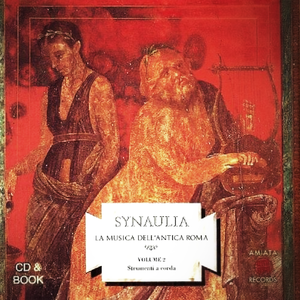
Music from Ancient Rome, Volume 2: String Instruments
Synaulia is a project consisting of Italian paleorganologist Walter Maioli (born in Milan, 1950) with his daughter Luce Maioli and Nathalie van Ravenstein. The name comes from the Greek synaulia, which in ancient Rome referred to a group of instruments consisting mainly of wind instruments. For over 30 years Maioli has been researching and practically testing (via the group Synaulia) the origins of music, sound and musical instruments. He has travelled extensively in southern Europe, northern Africa and and the middle east to study the traditional music of these areas. The project has involved building the ancient instruments to be played and then learning to play them. The group was founded and at first sponsored by a local museum in Leiden, Netherlands in 1995 by Maioli and choreographer and anthropologist van Ravenstein. In the beginning the Synaulia’s main task was mainly educational: the reconstruction of ancient musical instruments for the Dutch archaeological centre, Archeon. Later the scope was widened to include a more profound study into Italy’s music and dance focusing primarily on ancient Rome. The first Synaulia release was The Music from Ancient Rome, a two volume set, volume 1 released in 1996 being devoted to wind instruments and volume 2 released in 1999 being devoted to stringed instruments. Synaulia's music has been performed in many museums and ancient sites around the world. The Music from Ancient Rome has been performed in the appropriate settings of the Mausoleum of August and the thermal baths at Diocleziano. The fruits of Synaulia’s intensive study were used as material for films, serials and documentaries about ancient Rome. (among them The Gladiator by Ridley Scott which used the tracks Pavor and Etruria , and the BBC-HBO television series Rome), the use of the instruments for scholastic purposes, as well as in the publication of numerous articles on the subject. Read more on Last.fm. User-contributed text is available under the Creative Commons By-SA License; additional terms may apply.
Synaulia is a project consisting of Italian paleorganologist Walter Maioli (born in Milan, 1950) with his daughter Luce Maioli and Nathalie van Ravenstein. The name comes from the Greek synaulia, which in ancient Rome referred to a group of instruments consisting mainly of wind instruments. For over 30 years Maioli has been researching and practically testing (via the group Synaulia) the origins of music, sound and musical instruments. He has travelled extensively in southern Europe, northern Africa and and the middle east to study the traditional music of these areas. The project has involved building the ancient instruments to be played and then learning to play them. The group was founded and at first sponsored by a local museum in Leiden, Netherlands in 1995 by Maioli and choreographer and anthropologist van Ravenstein. In the beginning the Synaulia’s main task was mainly educational: the reconstruction of ancient musical instruments for the Dutch archaeological centre, Archeon. Later the scope was widened to include a more profound study into Italy’s music and dance focusing primarily on ancient Rome. The first Synaulia release was The Music from Ancient Rome, a two volume set, volume 1 released in 1996 being devoted to wind instruments and volume 2 released in 1999 being devoted to stringed instruments. Synaulia's music has been performed in many museums and ancient sites around the world. The Music from Ancient Rome has been performed in the appropriate settings of the Mausoleum of August and the thermal baths at Diocleziano. The fruits of Synaulia’s intensive study were used as material for films, serials and documentaries about ancient Rome. (among them The Gladiator by Ridley Scott which used the tracks Pavor and Etruria , and the BBC-HBO television series Rome), the use of the instruments for scholastic purposes, as well as in the publication of numerous articles on the subject. Read more on Last.fm. User-contributed text is available under the Creative Commons By-SA License; additional terms may apply.
Lyra Et Cithara
Baccus
Etruria
Magna Mater
Pavor
Diana
Mare Nostrum
Acutus
Lares
Imperium
Arena
Anima Vagul
Syriac Dance
Venus
Pastorale
Ludus
Fortuna
Aetherius
Isis
Tibia Duplex
Oraculum
Juppiter
Pompei
Tibiae Impares
Ludi Inter Pana Atque Nymphas
Invocation To Mercury
Animula Vagula
Tympanum
Salii
Neniae
Cithara And Sambuca
Orpheus
Ode To The Lyre
Erato
Pandura
Tiasus
Lyra And cithara
Symphoniaci
Synphoniaci
Cordae Obliquae
The Villa Of Mysteries
Sambuca Silences
Sacred Step
The Villa of the Mysteries
Pheobus
Sacred Steps
Phoebus
Pompeii
Cordae Obliqae
Sambuca-silences